One day, a person living in a country with an unstable currency told me that his savings were melting faster than he could earn his salary, and only Bitcoin helped him preserve at least something. He compared it to holding water in your hands, regular money slips away, while Bitcoin feels like turning it into ice, solid, limited, and independent. That was the first time he truly felt real freedom in managing his money. But where does such power come from in something you cannot physically touch?
What gives Bitcoin value and why it costs money
Bitcoin is a digital asset that has value because of scarcity, people’s trust, and real world usefulness. It costs money not because of any physical form, but because millions of people see it as a convenient way to store and transfer value, and are willing to exchange it for goods, services, or regular money. In reality, any currency works the same way, a banknote itself is just paper, and value appears because of shared trust.
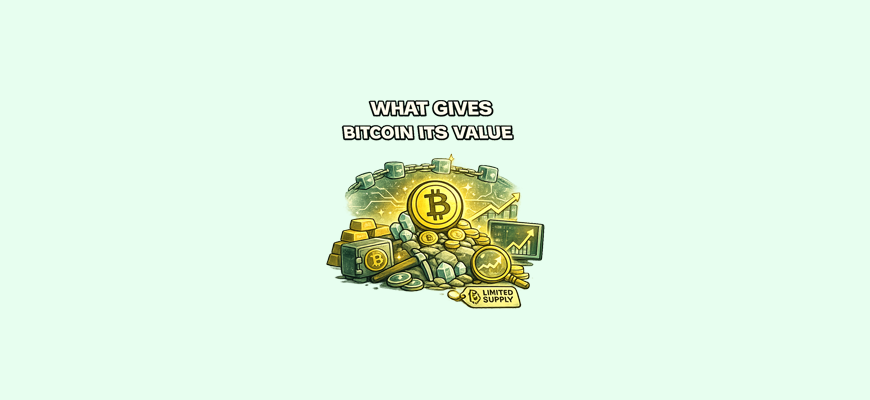
The main factors behind its value are limited supply, stable network rules, protection from counterfeiting, a high level of trust, and growing usefulness in everyday life.
A simple example:
Imagine there is a ticket to a popular concert, only a few were released, and everyone wants to get in, the price rises on its own. Something similar happens with Bitcoin, except this works on a global scale, and demand comes from millions of people and businesses.
When someone understands that Bitcoin combines scarcity, trust, protection from counterfeiting, and ease of use, the most logical conclusion follows, its price is real, not just “in words”.
Limited Bitcoin supply as the foundation of its value
There will only ever be exactly 21 million bitcoins in the world, no more can ever appear. This number does not change and does not depend on the wishes of governments or banks. Limited supply creates natural scarcity, and the more people want to own the asset, the higher its value becomes.
A simple example:
In a small town there is a rare stamp or coin, and there are far more collectors than available pieces, the price grows even without advertising. The same thing happens with Bitcoin, only on a global scale.
Regular money can be printed endlessly, which reduces its purchasing power. Bitcoin works differently, its supply is fixed, and that gives clarity about the future. This scarcity is exactly what became the foundation of Bitcoin’s long term value.
Decentralization as a reason for Bitcoin’s value and trust
Decentralization means that Bitcoin has no single owner or controlling center. It runs on thousands of independent computers around the world, and each of them stores part of the data. This is what gives the system resilience and security.
Users are protected from blocks, interference, and outside decisions. If one computer stops working, the network continues to function without interruptions. No one can simply change the rules, shut the system down, reset someone’s funds, or impose their own limits.
This creates trust, because when a system belongs to no one, it effectively belongs to everyone. That feeling of safety attracts more and more people. It is important to know that your money is under your control, not dependent on someone else’s mood or decisions.
Why Bitcoin cannot be counterfeited
Bitcoin is designed so that no one can create fake coins. New bitcoins appear only according to predefined rules. Every transaction is verified, the network confirms that the sender actually owns the coins, and only then is the transfer approved.
Any attempt to fake a transaction will simply be rejected by thousands of independent nodes. Transaction history cannot be changed, it is stored across the network and secured by many participants at once.
This makes Bitcoin a safe way to store money. People often fear losing funds due to fraud, and this is where the technology solves that problem. The system will not allow fake data or duplicated coins, and that is its core strength.
The practical value of Bitcoin for everyday people
Bitcoin allows you to store money without banks, you fully control your funds yourself. It works 24/7, and transfers are available at any time, even at night, on holidays, or with closed borders.
Transfers happen without intermediaries, and no one can cancel a transaction or limit the amount. This is convenient for people who support relatives abroad, pay for services in other countries, or simply want to transfer a large sum quickly without bank delays.
Bitcoin remains in demand whether the price goes down or up. People use it as a way to preserve value, as well as a tool for payments, buying goods, or paying for online services. It is not just an investment, but a working tool for everyday tasks.
Why Bitcoin is called digital gold
The comparison with gold appeared because of similar qualities. Gold is valued for its rarity, reliability, and global recognition, and Bitcoin combines the same traits.
It has a limited supply, cannot be counterfeited, and is suitable for long term value storage. The only difference is that gold is kept in a safe, while Bitcoin is stored in a digital wallet, but their value is formed by the same principle.
This comparison helps beginners understand the idea faster. Many people are used to valuable things being physical, and the gold analogy removes internal doubts, making the picture clearer.
Why people trust Bitcoin and how that affects its price
Trust exists because Bitcoin has been working reliably for many years, and the number of users grows every year. The more people use an asset, the higher its value becomes, this is a natural process.
Public adoption strengthens Bitcoin’s stability. It is used by stores, services, large companies, entrepreneurs, and everyday users. What matters is that its value grows not only because of technology, but also because of real trust from people.
When people are willing to exchange Bitcoin for money, goods, and services, it gains real value. This happens gradually, step by step, as more people understand its advantages.
Simple real life situations where Bitcoin’s value becomes especially clear
When a local currency is unstable, Bitcoin helps preserve savings because it does not depend on inflation or government decisions. Bitcoin’s price depends on different factors. People in many countries have already seen this from personal experience, and such situations make the technology even more in demand.
When you need to quickly send money to a relative or partner, Bitcoin allows transfers without delays, applications, limits, or unnecessary explanations. Speed and simplicity are key here.
When independence from banking rules matters, Bitcoin becomes a tool that is always at hand. It is protected from blocks, restrictions, and unexpected decisions from financial institutions.
Conclusion
Bitcoin’s value is created by a combination of scarcity, people’s trust, and real world usefulness. It allows you to store money without intermediaries, protects against counterfeiting, operates under transparent rules, and remains accessible regardless of banks or borders. Bitcoin helps preserve funds, freely manage them, and send them anywhere in the world. This becomes especially important when circumstances change or uncertainty grows. Understanding Bitcoin’s value makes it easier to see it not as a complex technology, but as a convenient tool that can be useful for anyone who wants to confidently manage their money.