One day, a student tired of side jobs turned on a computer built from old parts, and a couple of hours later heard a pleasant sound signal: the first coin was mined. He realized he was taking part in a global game where people all over the world solve computational tasks so the network stays honest and stable. For this contribution, the network “creates” new coins, as if thanking participants for their help. Cryptocurrency appears where millions of devices weave an invisible mathematical web. But is it really that simple?
Where cryptocurrency comes from and how it appears in the network
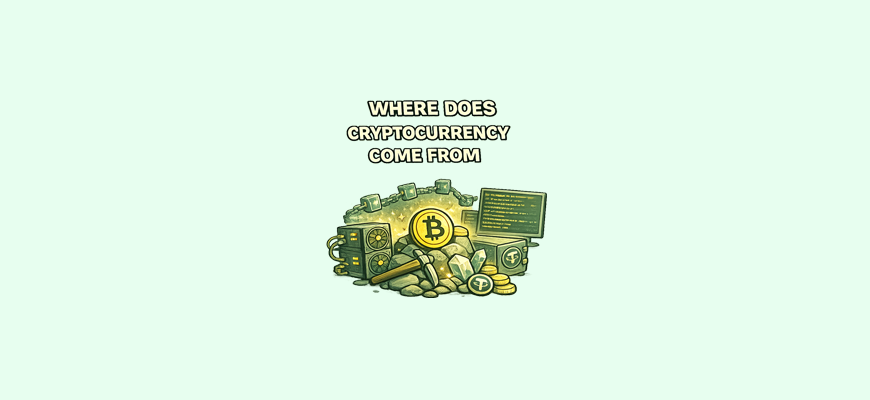
Cryptocurrency appears inside the blockchain, all the rules of its creation are written into the code in advance and are the same for everyone. These are not coins that someone prints by hand, but the result of the entire network’s work. When participants confirm transactions, perform technical tasks, and keep the network running, the system gives them a reward in the form of new coins. This is how cryptocurrency is created in the first place.
A simple example:
Imagine a large parking lot where every entry and exit is recorded by a system. For everything to work, you need someone who keeps order, checks license plates, and confirms operations. For each completed task, the system issues a token. You cannot get it just like that, bypassing the rules. These tokens are similar to cryptocurrency, except they are created not by a person, but by a program that clearly knows when a reward is deserved.
Blockchain does everything automatically, does not make decisions based on mood, and does not change the rules. That is why the appearance of coins looks like a strict process where everything happens clearly, transparently, and predictably.
How new coins are created step by step
The network collects transactions into one large package, and a block is formed from it. This block is sent for verification to those who support the network. These participants confirm that the data is correct and that users are sending what actually belongs to them. When the block is confirmed, the system records it in the chain, and at that moment a reward appears in the form of new coins.
This process always works the same way. It does not depend on people’s wishes, time of day, or external circumstances. The algorithm triggers the reward only when the block is fully created. No shortcuts and no exceptions. Everything is transparent, step by step, so the network remains reliable and stable.
Why cryptocurrency cannot be printed endlessly
The number of coins is defined in advance by code, and each cryptocurrency has its own limit. For example, Bitcoin has a fixed supply, and the system will not issue a single coin beyond that amount.
The code does not allow people to change these rules, so no one can simply increase the issuance. The lack of endless printing preserves value, because supply is limited and demand is formed by users. This works as protection against devaluation. Cryptocurrency is not diluted in massive quantities, so each coin keeps its significance.
How creating cryptocurrency differs from buying it
Creating coins means new units appearing inside the network. Buying means simply exchanging your familiar money for coins that already exist.
Almost all users get cryptocurrency through buying, not through creation. Creation requires technical infrastructure, equipment, time, and participation in network operations. Buying is available to anyone. You just open an app and make a regular transaction.
These two processes are often confused, even though they are completely different. Creation increases the total number of coins, while buying only redistributes existing ones between people.
Simple analogies for how cryptocurrency appears
Analogy with digital production
A coin cannot just appear out of thin air. It appears only when work is done. This is like a factory where products do not emerge on their own, they must be produced according to rules.
Analogy with game rules
To get a point, you need to perform an action. The system gives a reward only when a block is formed and verified by other participants. Not a step earlier.
Analogy with interest accrual
A bank accrues interest not on a whim, but according to rules. Blockchain does the same thing, except instead of interest, new coins appear. Everything follows an algorithm, everything is automatic.
What happens when all coins are created
When the limit is reached, the issuance of new coins will end, but the network will continue to operate normally. People will still be able to send and receive cryptocurrency, confirm operations, and use the system.
Participants who support the network will start receiving transaction fees. This is a natural transition when updating the coin supply is no longer needed and the network switches to a service-based model.
Coin creation is not an endless process, but a stage that exists only until all planned coins enter circulation. After that, the system fully lives off user activity, and this is normal for any mature cryptocurrency.
Why creating new coins requires effort
Cryptocurrency needs protection so that no one can change information. That is why coin creation is tied to technical work. When a network participant confirms blocks, they strengthen security, make hacking attempts more difficult, and keep the system reliable.
The reward motivates people to invest their resources in this work. If the network did not pay rewards, no one would support it for free. Thanks to this system, every participant understands what they receive coins for and why this task is important for the entire network.
This approach prevents chaotic coin creation, because rewards are given only for real contributions to the blockchain. This creates order and eliminates random or unjustified actions.
Summary
The appearance of cryptocurrency is a clear and structured process built on predefined rules and the work of network participants. Coins do not appear out of nowhere. Each one is created through completed tasks and maintained security. Understanding this helps you see cryptocurrency as a digital asset with real foundations, not just abstract numbers on a screen.
For a beginner, this gives a simple picture of what makes cryptocurrency valuable, why it cannot appear endlessly, and what stands behind its creation. This understanding helps you make more confident decisions when you deal with investments and want to understand what lies at the core of digital money.