Have you ever noticed how during rush hour traffic flows not because of one controller, but because hundreds of drivers follow the rules? In crypto, a node is like that “driver” who knows the route and checks it against everyone else. It stores data, verifies transactions, and does not take anyone’s word for it. That is why you can send money to a stranger on the other side of the world. But who decided these rules can be trusted in the first place?
What is a node in cryptocurrency
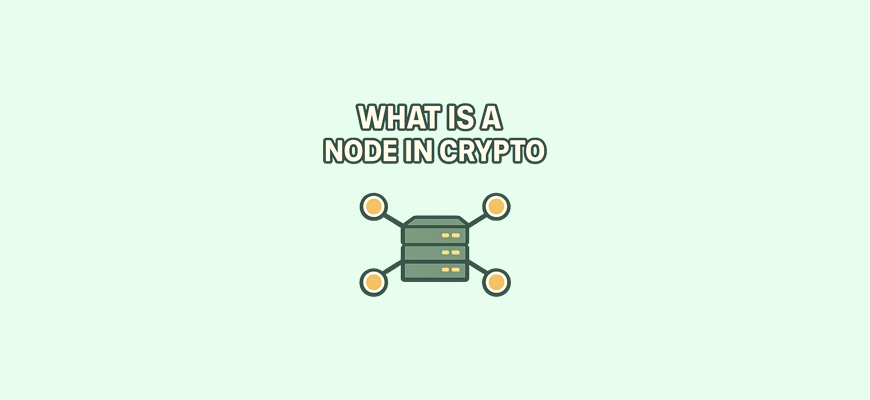
A node in cryptocurrency is just a regular computer or laptop connected to a crypto network or blockchain that helps it run properly. There is no mystery here. It is not a separate device and not something rare. Basically, it is a program running on a computer that constantly communicates with other computers like it.
The word “node” means a connection point. A network point. A link in the system. Every node is a participant in one shared system.
The basic task of a node is very simple. It verifies transfers, stores data about them, and makes sure everyone follows the same rules. If someone tries to send fake coins or break the rules, the node sees it and rejects that operation.
Example:
Imagine a huge shared notebook where all transfers are recorded.
Every node has its own copy of this notebook.
If an error appears in one copy, the other nodes simply do not accept it.
That is why a node is the foundation of any cryptocurrency. Without nodes there is no verification.
Without verification there is no trust. Without trust, cryptocurrency becomes just numbers on a screen.
Why nodes are needed in cryptocurrency
Nodes are needed so that cryptocurrency can work without a boss and without one central server. In a regular bank, everything is stored in one place. If the bank’s server is turned off or blocked, access to money disappears. In crypto, things work differently.
Information is stored by thousands of nodes around the world at the same time. Each node knows the rules and makes sure they are not broken.
Nodes constantly compare data with each other. If someone tries to change the history of transfers, the other nodes simply do not confirm it. This is how the network protects itself.
What happens if there are very few nodes. The data would be stored on a small number of computers. The network would become weaker and less stable. That is why the more nodes there are, the more reliable the cryptocurrency is. Nodes are also needed to preserve history. Transfers do not disappear.
They are stored for years. Even if some computers shut down, the remaining nodes still keep all the information.
What types of nodes exist in simple terms
There are several types of nodes in cryptocurrency, but for a beginner it is enough to understand two main types.
A full node is a node that stores the entire history of transfers from the very first day of the network.
It does not ask others and verifies everything on its own. This is the most reliable participant in the network. A full node requires more disk space and more time to operate. It constantly updates data and checks every new operation.
A light node is a simplified version. It does not store the full history, only part of the information.
For verification, it sometimes contacts full nodes.
Example:
A full node is like a person with complete accounting records for all years.
A light node is like a person who looks only at recent records and clarifies old ones if needed.
For a beginner, it is important to understand the difference so you do not get confused by terms.
But running any node for regular use is not necessary at all.
Do you need to run a node as a regular user
For most people, running a node is not needed at all. You can спокойно use cryptocurrency through a wallet or an exchange and not think about the technical side.
You can buy, store, and transfer cryptocurrency without your own node. All verification is already done for you by other participants in the network. Running a node can be useful if you want to understand more deeply how everything works. Or if you want to personally participate in supporting the network.
Sometimes nodes are launched for additional verification and independence.
In all other cases, there is no need to complicate your life. A node does not make you richer automatically. It does not increase your balance just because it is running.
For a beginner, the main thing is understanding the principle, not the technical implementation.
How a node works in general
After connecting to the network, a node begins to constantly communicate with other nodes. It receives information about new transfers and checks them according to the network rules. If the operation is correct, the node accepts it. If not, it rejects it. This way, decisions are made not by one computer, but by many at once.
A node must have internet access. Without a connection, it simply cannot receive and send data. It is like a phone without service, it exists, but it is useless. When people say that a node participates in the network, it means it helps maintain overall order. It does not control the network. It only confirms that everything is happening fairly. The more such participants there are, the harder it is to fake or break something.
Conclusion
A node in cryptocurrency is just a regular computer with software that helps the network operate honestly and without a central authority. It verifies transfers, stores data, and ensures the rules are followed.
You do not need to run a node to use cryptocurrency. It is enough to understand that behind the scenes thousands of such computers are working, ensuring the reliability and stability of the system.
Now you have a clear and calm understanding of what a node in cryptocurrency is and why it exists at all. This knowledge makes working with crypto more conscious and confident.