Have you ever chosen a route in a navigation app and seen several options: fast, free, and the most reliable? In the world of blockchains, almost the same thing happens. Different networks are created for different purposes. Some are perfect for sending money, others for games, and others for complex financial systems. They may look similar, but moving through them feels completely different. And the most interesting question here is not how many exist, but why there are so many. Are you sure you know the right route?
What blockchains exist
Blockchains exist in large numbers because they are different systems for transferring and storing data, money, and tokens, each designed for specific tasks. There is no single universal blockchain that is cheap, fast, convenient, and suitable for absolutely everything. Developers constantly create new blockchains because they are trying to solve different problems, speed, fees, convenience, security, scaling.
Put very simply, blockchain is like a separate road with its own traffic rules. Somewhere you can drive fast, but for a fee. Somewhere slowly, but reliably. Somewhere everyone is allowed in, and somewhere only with a pass. Imagine if there were only one road in the entire country. It would constantly be stuck in traffic. That is why there are many roads. Blockchains follow the same logic.
For an ordinary person, understanding this brings calm and control. You begin to understand why a wallet shows different networks, why one transfer costs almost nothing while another feels expensive, why the same token can appear in several versions. This is not confusion, it is simply different blockchains.
Example:
You send a package. You can send it by regular mail, by courier, or through a shipping company. The package is the same, but the delivery time, price, and rules are different. Blockchains are simply different ways to deliver cryptocurrency.
Main types of blockchains
All blockchains can be divided into several main types, and this is more than enough for a beginner to understand. There will be no complicated words or unnecessary details here.
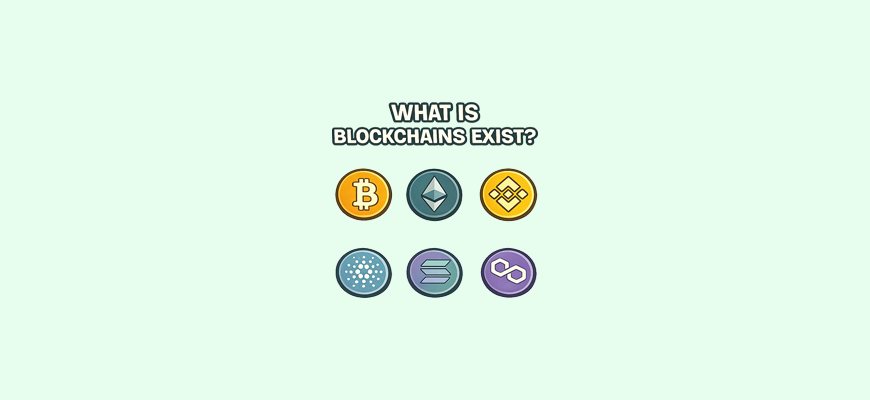
Public blockchains are open networks that anyone can use. You do not need permission, approval, or a contract. You simply create a wallet and start using it. These are the blockchains most often used in cryptocurrency. Bitcoin, Ethereum, BSC, Tron, Solana, all of these are public blockchains. They are transparent, transactions can be verified, and no one can simply cancel a transfer. It is like a public road where anyone can drive.
Private blockchains are closed networks that only certain people or companies can access. They are often used by banks, large corporations, and logistics companies. An ordinary person almost never interacts with them directly. Everything there is controlled by the owner of the network. It is like the territory of a factory where not everyone is allowed to enter.
Hybrid blockchains are a mix of the two approaches. Some data is open, some is closed. They are used rarely and mainly for narrow tasks. For a beginner it is only important to know that they exist, there is no need to dive deeper.
In short, when you buy cryptocurrency, send tokens, or use services, almost always you are dealing specifically with public blockchains.
Blockchains beginners encounter most often
Beginners often think that cryptocurrency is only Bitcoin. In reality, it is just one of many blockchains, and far from the most convenient for everyday operations.
Bitcoin is the very first blockchain. Its main purpose is storing value. It is reliable and time-tested, but slow and with relatively high fees. It is rarely used for frequent transfers. Most often people buy it and hold it like digital gold.
Ethereum is one of the most popular blockchains in the world. Thousands of tokens, services, and applications run on it. Beginners often encounter it when buying tokens, participating in projects, and using wallets. Fees can be high, especially during busy periods, but it is extremely widespread and supported almost everywhere.
Binance Smart Chain is often shortened to BSC. This blockchain became popular because of its low fees and high speed. It is often used for transfers, stablecoins, and working with services. Many beginners first realize that cryptocurrency can be fast and cheap here.
Tron is often used for USDT transfers. Fees are minimal and speed is high. People like it for its simplicity and convenience, especially when transferring funds between exchanges.
Solana, Polygon, and other networks are also commonly found in wallets and services. All of them exist because they offer their own advantages, speed, low fees, or convenience.
How blockchains differ from each other in simple terms
The most noticeable difference for an ordinary user is the fee. In one blockchain you might pay a few cents, while in another you might pay several dollars or even more. This is not a mistake and not a scam. Different networks simply work this way.
The second important difference is speed. Some blockchains process transfers in seconds. Others may confirm a transaction in several minutes. It depends on how the network is designed.
Blockchains also differ in what they were originally created for. Some focus on security and reliability. Others focus on mass transactions. And some are designed for services and applications.
There is no single best blockchain for everything. It is like there is no perfect transport for every situation. Walking is convenient nearby, a train is good for distance, a plane is fast but expensive.
Why it is important to choose the right blockchain
If you choose the wrong network when sending a transfer, the money may not arrive. Sometimes it can disappear forever. This is the most common beginner mistake, and it happens not because of stupidity but because of lack of knowledge.
The same token can exist in several blockchains at the same time. The name is the same, but the networks are different. If you send a token through the wrong network, the recipient will not see it.
A beginner should always check three things. The name of the blockchain selected when sending. Whether it matches the sender and the recipient. And what the fee and speed are. There is no need to rush. In cryptocurrency, attention is always more important than speed.
Summary
Blockchains exist because one system cannot handle every task. Some are built for storing value, others for fast transfers, and others for running services. When you understand that a blockchain is simply a system with its own rules, the fear disappears. You start choosing the network consciously, understanding fees, and not panicking because of unfamiliar words in your wallet. This knowledge gives confidence and saves money. Now you clearly understand what blockchains exist and why it matters for you.