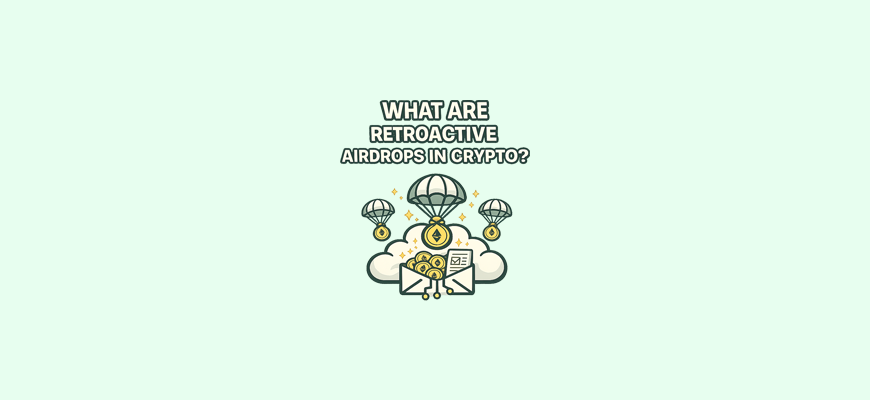
Have you ever signed up for a service just to try it, and then later got a bonus you never even imagined? In crypto, retrodrops work exactly like that: you interact with a project, and later it rewards you with tokens for your past actions. It feels like a lottery where you already bought the ticket without even noticing. Moments like that make you look at every click and transaction differently. Makes you wonder how many of those tickets you already have in your pocket.
What Are Retrodrops in Cryptocurrency
A retrodrop in crypto is a reward from a project to people who used its service in the past. You did something, moved funds, tried features, tested the platform. You did not know there would be a reward for it. Nobody promised you anything. You were just using it like a regular user.
The most important thing here is this: a retrodrop always looks back. After some time has passed, the project analyzes the history of user actions. Only then does it decide who to reward. That is why a retrodrop is not taking part in a promotion, it is gratitude for past activity.
Usually, people find out about a retrodrop unexpectedly. The project posts an announcement, or users start talking about it in communities. You open your wallet, check your account, and see tokens credited there. Sometimes it is a small amount, sometimes it is quite substantial.
Example:
You have been using the same gas station for years. You just fill up like usual. Then one day the company gives bonus points to all regular customers for the past year. You did not sign up for anything and you were not expecting it. That is the logic of a retrodrop, just in the world of crypto.
Why Projects Do Retrodrops
For a crypto project, the most valuable people are the ones who came early. When the service is still raw, unclear, and sometimes inconvenient. These are exactly the users who help the project grow, find bugs, and show that the product is actually needed by someone.
For the project, a retrodrop is a way to thank those people. Not with words, but with real value. It builds trust and creates a positive attitude toward the project. A person understands that their participation was noticed and appreciated.
A retrodrop also works well as advertising. People start telling others that they received tokens just for using the service. Others become interested in the project, try it, study it. All of this happens without direct promises or loud slogans.
It is also important that the distribution happens after the activity. The project first looks at real user actions. This helps filter out random people and reward those who actually used the service, not those who just showed up for one day.
How a Retrodrop Differs From a Regular Airdrop
The main difference between a retrodrop and an airdrop is the moment when the reward is received. An airdrop is almost always announced in advance. First, you are told what you need to do. Then you complete the conditions and wait for the tokens.
With a retrodrop, it is the opposite. First you act, then the project decides whether there will be a reward. You do not know the conditions in advance, and you cannot adjust your behavior to match them.
There is also a difference in the actions themselves. For an airdrop, minimal steps are often enough. Sign up, subscribe, complete a simple task. In a retrodrop, what matters is real use of the service, consistency, and engagement.
You cannot get a retrodrop by accident or just for nothing. If you did not use the project before, you simply will not be included. That is exactly why retrodrops are considered a more honest form of reward.
How a Retrodrop Works in Simple Steps
It all starts with a regular user. A person connects a wallet, goes to the platform, tries the features, carries out operations. They are not thinking about a reward and not waiting for one. They are simply exploring the service.
Time passes. The project grows, launches new features or a token. At that point, the team analyzes past user activity. They look at who used the service, how often, during what period, and how actively.
After the analysis, the conditions are formed. For example, using the platform before a certain date or completing several operations. If a user meets those conditions, tokens are credited to them. Usually this happens automatically, without any extra actions from the person.
What Actions Most Often Lead to a Retrodrop
Most often, retrodrops are given for real use of the service. This can include fund transfers, swaps, testing features, and working with the platform over time.
Consistency matters a lot. Projects value people who came back again and again. Logging in once and never returning is usually not enough.
The quality of the activity also matters. Formal actions done just to check a box often do not count. Projects try to see real participation, not an imitation of activity.
Why a Retrodrop Is Not a Guaranteed Reward
It is important to understand one simple thing. No project is required to do a retrodrop. It is their right, not their obligation. Even if you actively used the service, there may be no reward.
On top of that, activity does not always mean you qualify under the conditions. The project may only count a certain period, certain actions, or a minimum level of participation.
That is why a retrodrop should not be seen as a way to make money or as income. It is a pleasant bonus that may happen, or may not. It is better to treat it calmly and without expectations.
Conclusion
Retrodrops in crypto are a thank-you for past participation in projects. You use a service, explore it, try its features, and over time you may receive a reward you did not even know about. It is not a promotion and not a promise, but a nice surprise for active users. If you understand this logic and do not expect a guaranteed result, retrodrops become just a bonus, not a disappointment. Now you know exactly what retrodrops are and why they exist at all.