You pay for a purchase with your card and never wonder whether your bank actually holds your cash in physical form right now. USDT works in a similar way, you trust that something stands behind it. It promises to be an anchor in the stormy sea of cryptocurrencies, where everything moves and changes every minute. It is like a life buoy, you grab it without checking what is inside. But what exactly keeps USDT afloat and prevents it from sinking?
What backs USDT
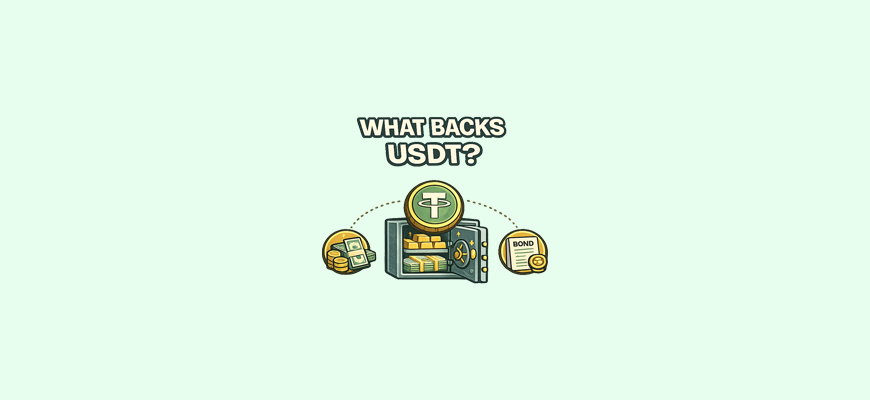
USDT is backed by real assets. This means every issued token represents actual financial value, not just numbers on a screen. When you hold USDT, you are essentially holding a digital equivalent of the dollar supported by specific resources. This does not mean your exact dollar bill exists somewhere with your number on it. It means the total assets correspond to the total amount of USDT in circulation.
The word “backed” here means there is a reserve. The company that issues USDT commits to holding assets equal to the amount of tokens issued. If 100 billion USDT exist, the assets should be roughly the same amount. This is what maintains trust and keeps the price from flying up or crashing down.
The peg to the dollar relies on this exact principle. People believe that USDT can be exchanged for real money when needed. As long as this belief is supported by assets, the system works.
Example:
Imagine buying a gift certificate from a large store. You agree to pay because you know the store actually exists and has products in stock. If the store printed certificates without having goods available, trust would disappear instantly. The same logic applies to USDT.
What assets back USDT
USDT is not backed only by physical dollars. The reserve usually includes a mix of different financial assets that together cover the issued tokens. Many beginners assume the company stores everything purely in cash dollars. In reality almost no one does that, not banks, not funds, not large corporations.
The reserve may include non-cash dollars held in accounts, short-term debt securities, deposits, and other financial instruments with a clear market value. What matters is not the exact form of these assets. What matters is that they have value and can quickly be converted into money when needed.
The relationship is simple. The more USDT that gets issued, the more assets must exist in reserve. If the number of tokens grows, the reserve grows as well. This is the core principle that has allowed USDT to exist for years.
Think of it like a warehouse of goods. If a store expands and sells more products, it increases inventory. If it sells more than it has in stock, the business will not last long. The logic in crypto is exactly the same.
Why USDT is not backed only by cash dollars
Keeping all reserves purely in cash dollars would be inefficient and risky. Money that sits idle loses efficiency. Storing huge amounts of physical cash also creates additional risks and complications.
Using different types of assets spreads risk and makes the system more stable. Some funds stay in highly liquid form, while other parts are placed in instruments that preserve value and remain accessible when needed. This is standard financial practice used by almost every large financial institution.
Banks do the same thing. When you deposit money, it does not sit in a safe labeled with your name. It is used within the system, while the bank still maintains reserves. USDT follows a similar principle, just in a digital format.
So the absence of 100 percent cash backing does not mean deception. It simply means the system works under the same logic as traditional finance.
How reserves help USDT keep the 1 to 1 dollar price
Reserves directly affect the stability of the USDT price. When the market knows that assets stand behind the token, people are willing to buy and sell it close to one dollar. This creates a balance between supply and demand.
Sometimes the price of USDT may be slightly above or below one dollar. This usually reflects market conditions. During panic moments, people may buy USDT more actively and the price can rise slightly. In calmer periods it may drop a little.
These fluctuations do not mean the reserves disappeared or the system broke. This is normal behavior for any financial instrument. Even traditional currencies sometimes move away from the expected value. The key point is that the deviations are small and temporary.
Think of USDT like a set of scales. If one side tilts slightly, the system still tends to return to balance.
What beginners should understand about USDT reserves
USDT is considered relatively stable, not perfectly stable. It aims to stay close to the dollar but remains part of the crypto market with its own characteristics. It is a tool, not a bank deposit.
It is also important to understand the basic risks. You trust the company that issues USDT and its reports about reserves. It is not a government currency and it is not protected by deposit insurance laws. Realizing this removes unnecessary illusions.
The key idea to remember is simple. USDT works as long as trust and reserves exist. As long as assets are present and the system remains transparent, USDT performs its role.
If you treat USDT as a convenient financial tool rather than a miracle, it becomes much easier to understand and use.
Conclusion
USDT is backed by real assets that together match the number of tokens in circulation. This is the foundation of its existence and the reason it stays close to the dollar. For you, USDT is a way to preserve value inside the crypto world without sharp price swings. Understanding what supports it gives clarity and confidence. You stop seeing it as a mystery and start treating it as a tool with clear logic and rules.