Imagine driving a car along a mountain serpentine with no brakes, relying only on luck and experience. As long as the road is smooth, everything is fine, but one sharp turn can cost too much. A stop-loss in cryptocurrency is your brakes that trigger automatically, even if you hesitate. It limits losses when the market starts acting unpredictably. In moments like this, it saves your deposit, not your nerves. Are you really ready to test the market without brakes?
What is a stop-loss in cryptocurrency
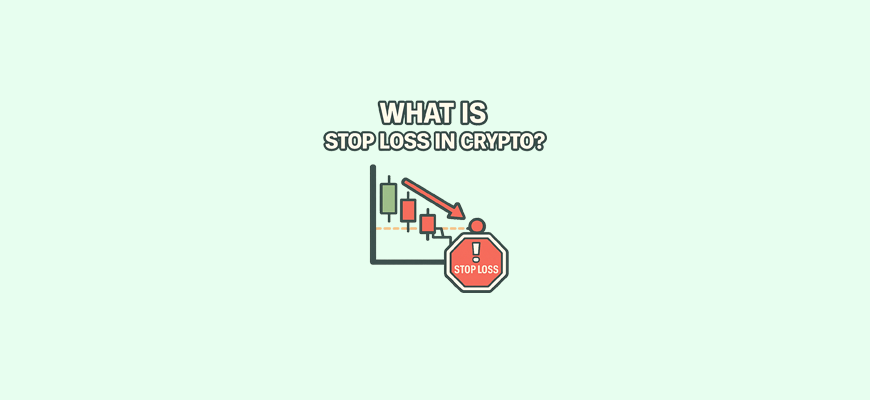
Stop-loss is an automatic sale of cryptocurrency when a заранее set price is reached. You decide where your exit point is, and the exchange closes the trade without your involvement.
Put simply, a stop-loss is needed so that your loss does not become bigger than you are willing to tolerate. You do not hope, guess, or sit there stressed. You make the decision in advance with a clear head.
For a beginner, a stop-loss solves one of the most painful problems, the fear of losing everything at once, especially when starting with small amounts and trying to understand what is the minimum Bitcoin you can buy. And by the way, this very fear often fuels the myth that Bitcoin is a pyramid. Without it, people often hold a falling coin for too long, hoping for a miracle. In the end, losses become many times bigger than they could have been.
Example:
You are walking down the street and see dark clouds. You take an umbrella, even if it has not started raining yet. A stop-loss is that umbrella. It does not cause the rain, it just protects you if it starts.
How a stop-loss works
You buy cryptocurrency at one price and immediately set a lower price at which you want to exit the trade. This is your stop-loss level.
What happens when the price reaches the stop-loss level. When the market price reaches this level, the exchange automatically sells your coin. You do not need to watch the chart, worry, or constantly check your phone.
Why a stop-loss triggers automatically. A stop-loss works automatically because it is a pre-set command. The exchange executes it on its own, even if you are sleeping or busy with other things.
Sometimes the selling price may be slightly worse than the stop-loss level. This is normal in cryptocurrency. The market can move sharply, and the trade is closed at the nearest available price. The important thing is that you exited the trade and stopped further losses.
Types of stop-loss
There are two main types of stop-loss, and it is important to understand the difference.
What is a stop-market and when it is used. Stop-market means that when the target price is reached, the coin is sold immediately at the current market price. This is the most reliable way to exit a trade. It is used when the fact of exiting matters more than the exact price.
What is a stop-limit and how it differs. Stop-limit works differently. You set the price at which the order is activated and the price at which you want to sell. If the market moves too fast, the trade may not be executed at all.
For a beginner, stop-market is much simpler and safer. It does not require extra settings and almost always executes, even during sharp market moves.
Where to place a stop-loss as a beginner
The simplest option to start with is to calculate a stop-loss as a percentage of the purchase price. For example, you are ready to lose 5 or 10 percent of the trade amount.
Why you should not place a stop-loss too close. A stop-loss that is too close often becomes a problem. The price can fluctuate slightly up and down, and you will be knocked out of the trade even though the movement was normal. This causes frustration and makes it feel like the tool does not work.
How to determine an acceptable loss in advance. Before entering a trade, it helps to ask yourself a simple question. How much am I ready to lose calmly, without stress. If the answer feels uncomfortable, the risk is too high, and it is better to reduce the amount or not enter at all. A stop-loss should protect you, not get in your way.
How to set a stop-loss on a crypto exchange
On any exchange, the logic is примерно the same, even if the buttons look different.
What data you need to enter when setting a stop-loss. You need to set the price at which the stop-loss will trigger, choose the order type, and specify the number of coins. In essence, you are telling the exchange, if the price reaches this level, sell automatically.
What to check before confirming. Before confirming, make sure to double-check all the data. A mistake in numbers or order type can lead to unexpected results.
It is better to spend an extra minute checking than to later figure out what went wrong.
Common beginner mistakes when using a stop-loss
Why a stop-loss often triggers right after entry. One of the most common mistakes is placing the stop-loss too close to the purchase price. As a result, it triggers almost immediately, and then the price reverses upward.
Why you should not move a stop-loss because of emotions. Another mistake is moving the stop-loss lower because of emotions. The price drops, and a person thinks it is better to wait. This is how a small loss turns into a serious one.
Why misunderstanding order types is dangerous. Beginners also often confuse order types. Using a stop-limit without understanding it can lead to the trade not being executed at all, and the protection not working.
Why a stop-loss is protection, not a mistake
Why triggering a stop-loss is normal. A stop-loss being triggered is a normal working situation. It is not a failure and not a sign that you did something wrong.
Why a stop-loss helps preserve your deposit. A stop-loss helps preserve your deposit. And preserved money gives you the chance to continue, learn, and gain experience.
Why a stop-loss is more important than trying to guess the market. It is impossible to constantly guess the market. Even experienced people make mistakes. The difference is that they have protection, while beginners without a stop-loss do not.
Conclusion
A stop-loss is a simple and clear tool that limits your losses in advance and removes unnecessary emotions. It is not for perfect trades, but for real life, where the market can behave unpredictably. If you understand what a stop-loss is and use it from the very beginning, you preserve not only your money, but also your peace of mind. This is exactly where a normal, conscious path in cryptocurrency begins.