When people crowd at the entrance of a restaurant, the place speaks for itself even without ads. In crypto, the role of that “popular restaurant” is played by TVL, Total Value Locked. It shows how much money users have already brought into a project. The higher the TVL, the more people believe this platform is reliable. But does the crowd always know where it is going?
What is TVL in cryptocurrency
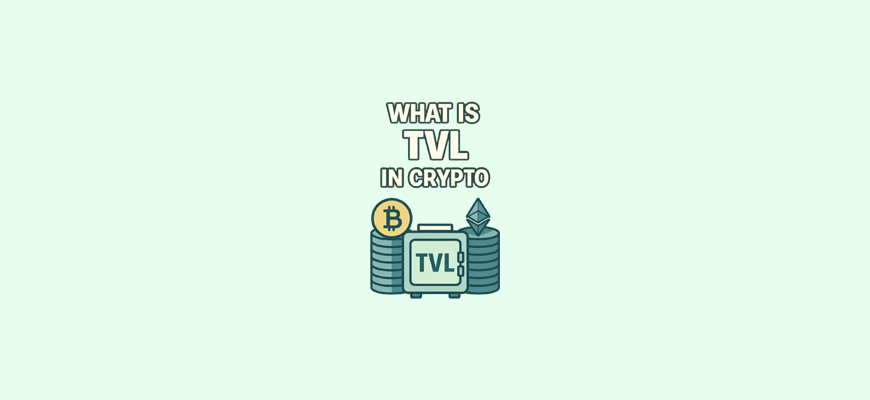
TVL (Total Value Locked) is the total amount of funds that users have invested in a crypto project. Simply put, it is the total volume of money “locked” inside a platform so it can work, run swaps, issue loans, pay rewards.
Imagine a piggy bank where everyone puts in money. The more people and the bigger the amounts, the higher the TVL. This money is not stolen and not frozen, it actively works inside the system. In return, the platform pays interest or other rewards. Everything is transparent and fair, because the system runs on smart contracts, without intermediaries.
TVL helps you understand how popular and reliable a platform is. If TVL is high, it means people have already trusted it with large sums. And if nobody wants to enter, why should you?
TVL is especially important in DeFi. These are decentralized applications like exchanges, wallets, lending services. They work without banks or intermediaries, only on code. And for the system to function, it needs user funds.
Real life example:
Imagine you are choosing between two construction companies. One already has a billion invested by clients, the other only a couple of million. Which one inspires more trust? The answer is obvious. TVL works the same way. It is a guide for beginners that helps you avoid getting burned.
How TVL is calculated
The TVL formula is very simple:
TVL = number of coins × current coin price
Example:
Let’s say a project has 50,000 ETH locked, and the price is $2,500.
TVL = 50,000 × 2,500 = $125,000,000. That is the total amount.
But it does not end there. Why does TVL constantly change?
There are two reasons:
- Changes in the cryptocurrency price. If the coin price goes up, TVL goes up. If it drops, TVL drops too.
- Changes in the number of coins. People can withdraw funds or add more. This also affects the number.
That is why TVL is a living metric. It moves every day. Sometimes every hour.
Where to check current data?
Here are reliable resources:
- DefiLlama
- DefiPulse
- DappRadar
There you can track:
- TVL by projects
- Daily, weekly, monthly dynamics
- Comparison across blockchains like Ethereum, Solana, BNB, and others
The more information you have, the lower the risk of making a mistake.
Why TVL matters
TVL is not just a number. It is a mirror of user trust in a project.
If you see a platform with a TVL of $3 billion, it means a lot of people trusted it with their money. They checked it, evaluated it, and made a decision.
Here is what a high TVL also tells you:
- Popularity, thousands or millions of users are already there
- Reliability, nobody puts money into something obviously shady
- Growth, more money means more opportunities to develop and add new features
When TVL grows, it is almost always a good sign. People bring money, the platform lives and develops. But if TVL drops sharply, you should look into why. Maybe users are pulling funds because of project issues.
TVL is like the pulse of a crypto project. It shows whether the “heart” is beating strong or skipping.
Weak sides of TVL
TVL is useful, but you should not trust it blindly. Because it can be misleading.
Here is how:
- Projects can inflate TVL artificially. For example, they offer huge bonuses for depositing funds. People come not because they trust the project, but to grab rewards. When bonuses end, everyone leaves. TVL crashes.
- Crypto prices affect TVL. If a coin price collapses, TVL falls too, even if the actual number of coins stays the same. So a sharp TVL drop is not always a reason to panic.
- TVL does not show who owns the funds. Sometimes one big whale can deposit a massive amount and create the illusion of activity. In reality, the project may be empty.
That is why TVL is not the only metric. Look at reputation, reviews, developer activity, code audits. Only together do they give a full picture.
How beginners can use TVL
You are new and do not know where to start? TVL is a great starting point. Here is how to use it:
- Compare similar projects. For example, you choose between two decentralized exchanges. One has a TVL of $10 million, the other $1 billion. It is obvious where there is more activity and trust.
- Watch the dynamics. The current TVL matters less than how it changes. Steady growth is a good sign. If it goes down, check the news, there may be problems.
- Use TVL as a filter. It helps quickly cut off questionable platforms. If a project has tiny TVL, it is likely unfinished or even a scam. Better stay away, especially at the beginning.
- Do not rely on one metric only. TVL is just one piece of the puzzle. But if you learn to use it properly, you can avoid many mistakes.
Conclusion
TVL shows how much money users have trusted to a crypto platform. The higher the number, the more people have already tested it and invested. For beginners, this helps answer a simple question: is it even worth dealing with this?
But TVL is not a cure-all. It does not show the full picture. A project can be popular but unreliable. Or the opposite.
For beginners, TVL is a simple way to navigate the crypto world.
Look, compare, and do not forget common sense. Then your chances of ending up in a solid project will be much higher.