Imagine taking a taxi to the airport but misjudging the timing, traffic hits, you’re late, the plane is gone, and your tickets are burned. That’s roughly how liquidation works in crypto: you bet on growth, but the market goes down, and the system simply “closes the door” without you. That’s it. The money is gone, and there’s no way back. The crypto world doesn’t forgive mistakes. Would you take that risk knowing there’s no second chance?
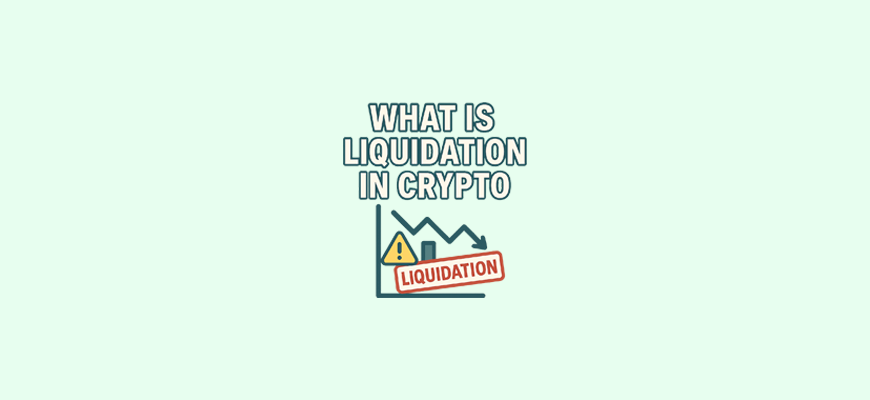
What Is Liquidation in Crypto
Liquidation is the forced closure of your losing position on an exchange when you trade with borrowed funds and the market moves against you — a common risk across Web3 trading.
Imagine: you have $100. You want to earn more and use leverage x10. This means the exchange “adds” another $900, and now you’re trading with $1,000 — often using collateral like USDT. But as soon as the price starts falling and the loss reaches those $100, the exchange closes the trade and takes your entire collateral.
You won’t be able to change your mind, you won’t get a warning, you won’t be able to cancel the trade. Everything happens automatically. You’re left with nothing.
That’s liquidation: a total loss of your investment because the market went the opposite way from what you expected.
A simple example:
You walk into a casino and put absolutely all the money you have on black, $568. You risk everything, no backup. Red comes up, and you’re left with zero. You’re not in debt, but you lost everything. That’s exactly how liquidation works in crypto: you place a bet, the market goes against you, and your balance is wiped out.
How Liquidation Works
To understand liquidation, it’s important to see what’s happening behind the scenes on the exchange (and in DeFi futures protocols too):
- You open a trade. Let’s say you’re sure Bitcoin will go up. You deposit $200, take x5 leverage, and trade with $1,000.
- The price moves against you. Bitcoin doesn’t rise, it falls.
- The exchange tracks your PNL. If the loss gets close to the $200 you invested, it steps in.
- The “liquidation price” is triggered. This is a pre-calculated level where your entire collateral turns into a loss.
- The position is closed automatically, and you lose everything you invested.
And it doesn’t matter how confident you were. Even if the market later recovers, the lost money is gone forever.
The higher the leverage, the closer the liquidation price. With x2 you risk less, with x20 a price move of just 5% is enough to lose everything.
Why Liquidation Happens
Liquidation most often occurs when trading futures, where leverage is used. There are three main reasons why beginners regularly lose their deposits:
1. Excessive leverage
People want fast money and take x10, x20, sometimes even x100. It’s tempting, but extremely dangerous. One small move against you, and you’re already on the edge of liquidation.
2. Crypto market volatility
The crypto market is unstable. Coins can drop 15% in a couple of hours — especially smaller tokens that once came to market via an ICO. If you’re trading with leverage, you simply won’t have time to react.
3. Ignoring risk management
Beginners often don’t set stop losses, don’t understand how much they’re willing to lose, and don’t watch risk indicators. They trade “on luck”. The result is losing all their money.
Understanding these reasons is already half the battle. But the next step is action.
How to Avoid Liquidation
Want to keep your money? Three simple rules:
Always set a stop loss
This is your lifebuoy. It closes the trade before the price reaches liquidation. Better to lose $20 than $200. Without it, you’re like a driver without brakes.
Don’t use high leverage
The higher the leverage, the faster the market will wash you out. Beginners are better off starting with x1.5 to x2, and only increasing it later with experience.
Close losing trades manually
If you see the market isn’t going your way, don’t wait for a miracle. Close the position yourself. Taking a loss hurts. Waiting for liquidation is self-destruction.
Many exchanges allow you to set automatic closure at a certain loss. Use it.
Conclusion
Liquidation is like punishment for excessive greed. You wanted to earn more than your funds allowed, and you paid for it.
It doesn’t happen by accident. It can always be avoided if you follow simple rules: set stop losses, don’t take high leverage, and don’t ignore exchange signals.
Now you know what kind of beast liquidation is. It’s not just a word, it’s a real threat to your capital.
Remember: in crypto, the main thing isn’t to make money fast, but not to lose it fast.