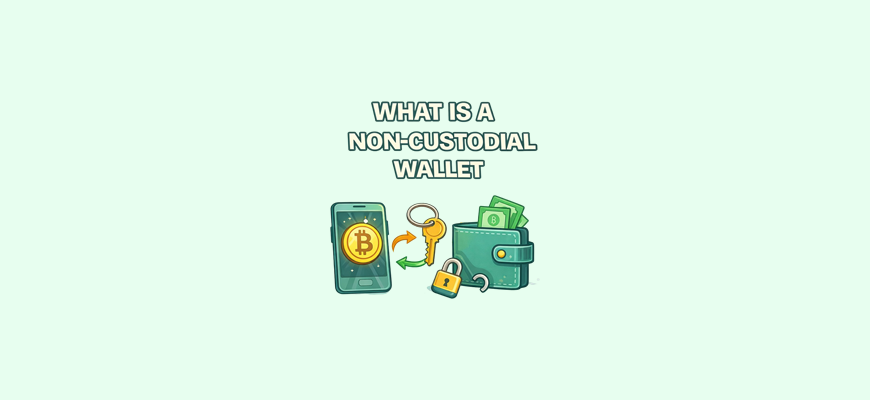
Imagine you have a safe that only you know the code to. No bank, no government, no hacker can break into it. That is exactly how a non-custodial wallet works, this is when the money truly belongs to you. But are you ready for that level of freedom, without a “Recover password” button?
What is a non-custodial wallet
A non-custodial wallet is a personal crypto storage that only you can access. No one else controls your money. Not an exchange, not a bank, not an intermediary. Only you.
The word “non-custodial” comes from English and literally means “without a custodian”. That means there is no third party holding your funds or deciding what happens to them.
Custodial wallets work differently. There, your funds are stored on someone else’s server. In practice, you trust your money to a platform. It stores it, processes transactions, and if something goes wrong, a hack, a freeze, a failure, you can do nothing.
With a non-custodial wallet, it is the opposite. Keys, passwords, access, only you have them. No one can freeze your account or take your funds away.
A simple example:
Imagine you have a garage with a car.
- In the custodial option, the garage keys are with a guard. To get inside, you need their permission.
- In the non-custodial one, the key is only with you. You want to come in, open it, drive away. No one asks where or why.
The same with crypto money. Your wallet is your personal digital safe.
How a non-custodial wallet works
To understand the principle, let’s break it down step by step.
When you create a wallet, it generates a private key, a long string of characters that works like a password. This key proves that you own a specific wallet. Without it, no one can sign a transaction and send your money.
To make sure you do not lose this key, the system shows you a seed phrase. This is a set of 12 or 24 words, for example: “cat river orange stone…”. These words are like a backup key to the safe. If you lose your phone or delete the app, only this phrase can restore access.
The money itself is not stored inside the app. It lives on the blockchain, a huge distributed network. Your wallet simply shows your balance and lets you manage it.
When you send crypto, your private key creates a digital signature. This signature confirms the transaction, and the blockchain records it forever. Simple and secure, as long as you do not lose your keys.
What is the difference between custodial and non-custodial wallets
The difference is massive, and it is all about control over your money.
- A custodial wallet means your funds are held by a third party. This can be an exchange, a bank, or a service. It is convenient: you do not need to remember keys, and access can be restored through support. But there is a downside. Your money is not fully under your control. The service can freeze your account, face sanctions, go bankrupt, or simply disappear.
- A non-custodial wallet is the opposite. No one except you has access. Even if the entire internet goes down and the platform disappears, your coins stay on the blockchain, and you can return to them with your seed phrase.
A simple analogy:
A custodial wallet is like a bank where your money is locked by someone else.
A non-custodial wallet is like a safe at your home. Yes, you are responsible for the key, but no one interferes.
For a beginner, it is best to start with a non-custodial wallet. It immediately builds the right habit, being the owner of your funds. At first it feels unusual, but over time you realize one thing: financial freedom requires personal responsibility.
Advantages of a non-custodial wallet
- Full control. Only you decide when, where, and how much to send. No one can limit your actions.
- Independence. The wallet does not depend on banks, exchanges, or countries. Even if new sanctions appear tomorrow, your money stays safe.
- Simplicity. Once set up, everything is easy. Open the app, confirm the transaction, done.
- Privacy. No one can look into your balance or know how much you have.
- No intermediaries. Direct transfers, without third-party fees.
- Freedom. This is your money. Store it, spend it, as you wish. No permissions, no bureaucracy.
Many people who try this approach never go back to banks. The feeling that everything is under your control gives real confidence and independence.
Main risks and how to avoid them
Where there is money, there is responsibility. The most common beginner mistake is losing the seed phrase. Without it, access cannot be restored. Even the wallet creators cannot help.
Write the words down on paper right away, preferably in several copies, and store them in a safe place, for example in a home safe or a bank deposit box.
Never store the phrase on your phone, email, or notes app. Hackers love those places.
The second threat is phishing sites and fake apps. They look real but steal your data. So:
- Download wallets only from official sources like Google Play, the App Store, or the official website.
- Check the site address carefully. One extra letter can cost you money.
- Never enter your seed phrase anywhere except inside your wallet.
One more important rule: support will never ask for your keys or seed phrase. If someone writes pretending to be wallet support and demands this data, it is a scam.
For extra protection, you can enable two-factor authentication and install antivirus software. It may seem minor, but small things often save you from big losses.
How to start using a non-custodial wallet
- Choose an app. Popular options include Trust Wallet or Metamask. They are free and easy to use.
- Download and install it. Only from official sources.
- Create a new wallet. The system will show you a seed phrase. Write it down by hand and hide it. Do not take screenshots.
- Check that it works. After setup, you will see your wallet address, a long string of letters and numbers.
- Add funds. You can transfer a small amount of crypto from an exchange or receive it from someone you know.
- Send your first transaction. Try a small amount to understand how it works.
After a few minutes, you will feel it. It is not as complicated as it seemed. Everything is intuitive, and the feeling of control is incredible.
Final thoughts
A non-custodial wallet is not just a way to store crypto. It is a tool of freedom. With it, you fully control your money, without intermediaries, without blocks, without fear that someone will freeze your account. It is your personal digital safe, where the power belongs only to you.
Yes, you need to be careful and protect your seed phrase. But the reward is worth it. You become independent from systems and rules set by others. You control your wealth, your decisions, and your future.
The world is moving toward digital freedom. And a non-custodial wallet is the first step on that path.