You wake up, open the app, and the market is falling. Everything is going down, but your balance is going up. This is trading in reverse. You are swimming against the current and making money. While the crowd panics and shouts, “I’m selling!”, you are already buying. Everything works the opposite way here, the worse it is for everyone else, the better it is for you. Ready to play by these rules?
What is a short in crypto
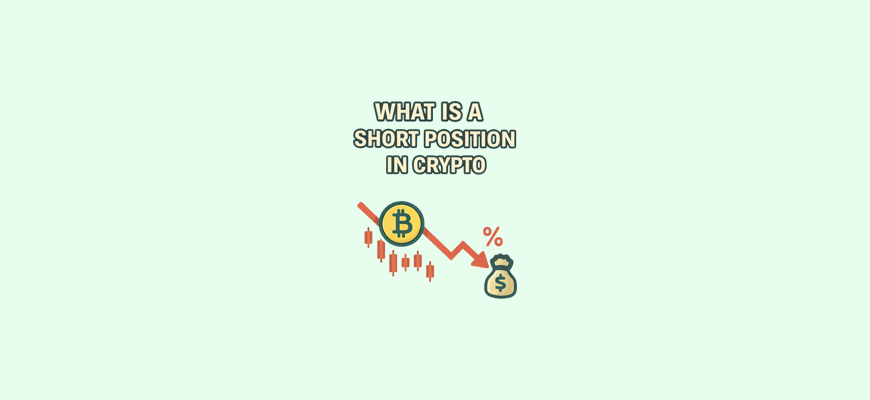
A short (or short position) is a way to make money when the price of a cryptocurrency falls. Unlike a classic buy, where you profit when the coin goes up, here everything is reversed. The harder the price drops, the more you earn.
Imagine Bitcoin is worth $100,000 right now. You do not buy it. You borrow the coin from the exchange, immediately sell it at this price, and wait. If the price drops to $90,000, you buy the coin back and return it to the exchange. That $10,000 difference is your pure profit.
How is this possible if you do not own Bitcoin in the first place? Exchanges allow you to temporarily borrow crypto through built-in mechanisms. It is legal, it works through automated smart contracts, and you must return the coin itself, not the money you sold it for.
A simple example:
Your friend owns an expensive camera lens. You borrow it and sell it for $1,000. A week later, you see the same lens in another store for $700. You buy it, return the lens to your friend, and keep the $300 difference.
But if the lens goes up in price, say to $1,200, you still have to buy it back to return it. In that case, you take a $200 loss.
How a short works in crypto
To understand how it works, let’s break it down step by step.
- You borrow a coin from the exchange. This happens automatically, you just click “Open Short” or “Sell”.
- You sell it at the current price. For example, at $100 per coin.
- You wait for the price to fall. Let’s say to $80.
- You buy the same coin back at the lower price.
- You return the asset to the exchange.
- The difference is your profit. Minus fees and borrowing interest.
If the price goes up instead, you take a loss. The higher it rises, the more you lose. That is why risk control is critical when shorting.
This is where another concept comes in, leverage. It allows you to open a position larger than your actual balance. For example, with x5 leverage, having $100, you can short $500. Profits grow faster, but risks grow as well.
It is like going to a store with $1,000, and the cashier lets you take $5,000 worth of products. If prices fall, you win. If they rise, you owe money.
Why people choose to short
Today a coin is worth $10, tomorrow it is already $7. Many people think, “Why not make money on this drop?”
And it makes sense. When the market crashes, regular buyers lose money. Short sellers make money. It feels fair, especially if you enter the market during a downturn and do not want to just sit and wait for growth.
Sometimes shorting is more profitable than buying. For example, if you are sure a correction or panic is coming. Or bad news hits the market.
But there is another side. Shorting is not intuitive. You need to react fast, calculate risk levels, set stop losses, and read charts. One mistake can be expensive.
Without experience and understanding how leverage works, shorting turns into a minefield. Many beginners lose money because they open trades “hoping for luck”, without calculations.
A short is like a sharp knife. You can cook dinner with it, or you can cut yourself. It all depends on how you use it.
How to safely try shorting
If you want to try it, start simple. Below is a step-by-step guide on how to safely open your first short position.
- Choose a reliable platform. We recommend Bybit, one of the most popular exchanges. Beginners get $50 for sign up and up to $30,000 in deposit bonuses.
- Fund your account. Start with a small amount, ideally $50–100.
- Choose a cryptocurrency. For your first trade, Bitcoin is a good option. It moves smoother and is more predictable.
- Open a short. Click “Sell”. Set a stop loss to limit potential losses.
- Watch the chart. If the price goes down, take profit. Do not wait for “just a bit more”.
- Close the trade. Click “Close position”. The system buys the coin back at the new price and returns it to the exchange.
Important: do not use leverage at the start. Even x2 is already risky. First understand how the system works without borrowed funds. Only then think about increasing position size.
How not to lose money when shorting
Shorting means working with borrowed assets, and that comes with specific risks.
Liquidation happens when the exchange closes your trade automatically. This occurs if the price moves against you and you lose almost your entire deposit. To avoid this, always set a stop loss and never use your full account balance in one trade.
Leverage mistakes. Many beginners use x10 or x20 to earn more. The market makes a sharp move, and you get liquidated instantly. It is better to earn small amounts consistently than lose everything in seconds.
Panic and emotions. You open a short, the price goes up, and you close the trade in fear. Half an hour later, the price drops again. You need discipline and a clear strategy, not emotional jumping between trades.
Never open a short without calculations. Not “for luck”, not “based on rumors”, not “because everyone says so”. Only numbers. Only analysis.
How to calculate profit and loss when shorting
Let’s say you open a short for $100. The coin price is $10. That means you sell 10 coins.
If the price drops to $8, you buy them back for $80, return the debt, and keep $20 as profit.
If the price rises to $11, you need $110 to buy them back. That is a $10 loss.
To avoid unpleasant surprises:
- Set a stop loss so the trade closes at an acceptable loss.
- Set a take profit so you do not miss the moment to lock in gains.
These settings are configured when opening a position. Do not ignore them, they protect your money.
Conclusion
Shorting in crypto is a way to earn when the market goes down. You borrow a coin, sell it at a higher price, then buy it back cheaper. Everything is transparent and rule-based. The exchange acts as the intermediary.
Shorting is a tool for calculation, not emotions. If you approach it wisely, you can profit from market drops. If you blindly chase gains, you can lose your deposit in minutes.
Is it hard? Maybe. But it becomes much clearer once you actually try.
All that is left is to take the first step.