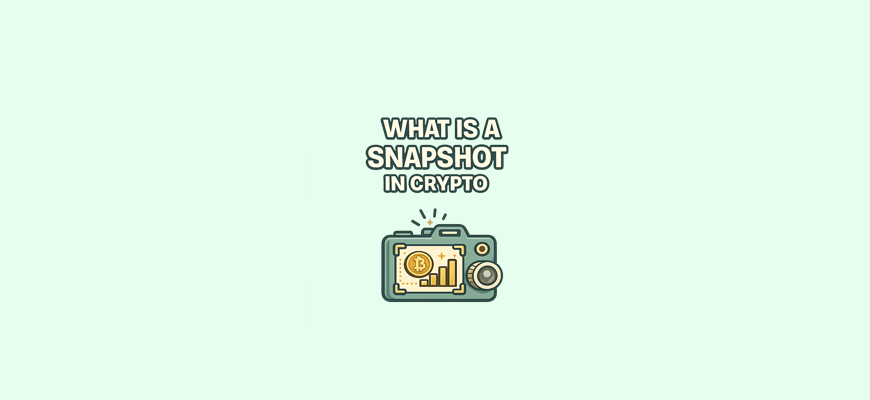
Imagine you take a photo of the family table before a holiday so you know exactly who was sitting where, no one disappeared and no one suddenly appeared. In crypto a similar principle works. At one specific moment the network “takes a photo” of wallet balances. This digital snapshot records how many tokens each address had at that exact second. Later, even if everything changes, that frame stays the same. But why does the blockchain need these “photos” and why can your money sometimes depend on them?
What is a snapshot in crypto
Snapshot in crypto is the recording of the state of the blockchain at a specific moment in time. Simply put, the network looks and records who had how many coins or tokens at that second. Not earlier and not later. Exactly at that moment.
Look, the blockchain is constantly active. Coins are transferred, sold, bought, and moved between wallets. If a project needs to understand who owned what, it cannot take data “approximately”. That is why a snapshot is created. It is like pressing pause and saving a frame.
During a snapshot nothing is frozen and nothing is blocked. Your coins remain with you. You can continue using them. A snapshot does not take or deduct funds. It simply records information, like an accounting note.
What gets recorded is not a person but a wallet address. The blockchain does not care who you are. It only sees numbers and addresses. If an address had 10 tokens at the moment of the snapshot, the system will remember it.
Why a snapshot is needed
Snapshots are needed by projects to distribute bonuses, new coins, or rights inside the system fairly. Without a snapshot this would be impossible.
A project cannot ask every user how many coins they had. It cannot trust words. The only way is to record the data inside the network and rely only on it afterward.
A snapshot helps avoid disputes. No one can say they were left out on purpose. There is a record in the blockchain and it does not change. It is like a store receipt that confirms a purchase.
Snapshots are also used during major changes. For example, when a project launches a new version, changes rules, or splits one coin into two. It is important to know exactly who participated under the old conditions.
Without a snapshot there would always be unhappy users. Someone bought later and would want a bonus. Someone sold earlier and would also want to receive something. A snapshot creates a clear boundary.
When a snapshot is used
Most often snapshots are used during distributions. The project announces the date and time in advance. Everyone who holds coins on the required wallet or exchange at that moment participates.
Snapshots are also used when launching new tokens. For example, you had an old coin and the project releases a new one. The snapshot is used to calculate how many new coins you will receive.
Sometimes snapshots are used for voting. The system records how many tokens each address has, and that weight determines the vote.
There is always a specific moment defined. It can be a date, time, or block number. Without this a snapshot loses its meaning. In crypto there is no “more or less”, only exact values.
Why the snapshot date matters
The snapshot date decides everything. Even a few minutes can completely change the result.
If you bought coins before the snapshot, the system will see them. If you bought them after, the system will not count them anymore. Blockchain does not guess and does not assume.
The same applies to transfers. If you sent coins to your wallet at the last moment but the transaction did not go through in time, then for the snapshot those coins were not considered yours. Even if they appear in your wallet a minute later.
Many beginners get into unpleasant situations because of timing. They do everything correctly but too late. In crypto time is not a recommendation, it is a rule.
That is why it is always important to leave a margin. Do everything earlier, not during the final hour.
How a snapshot looks for a regular user
For a regular user a snapshot usually happens unnoticed. No notifications, no buttons, and no confirmations. You simply hold coins on the required wallet or exchange. At the specified moment the system records the balances. That is all.
You do not need to press anything. You do not need to confirm anything. If the conditions are met, you already participate. Users usually learn that the snapshot happened from project news. Sometimes it becomes visible later when bonuses or new tokens arrive.
It is important to understand that a snapshot does not mean an instant result. It is only a record. Rewards may come later, sometimes weeks later.
Common beginner mistakes
The most common mistake is confusing a snapshot with a distribution. People expect something to appear in their wallet right after the snapshot. But a snapshot is not a gift, it is a record.
The second mistake is ignoring the conditions. The wrong wallet, the wrong network, or the wrong exchange. As a result the snapshot happened, but the person was not included.
The third mistake is acting at the last moment. Transfers, purchases, and movements minutes before the record often end with the system not seeing them.
Another mistake is believing rumors. Someone said “you can do it later” or “nothing will happen”. In crypto official project information always matters.
Conclusion
A snapshot in crypto is a simple and strict recording mechanism. It exists to determine fairly who had what at a specific moment in time. For you it means one thing. If you know the snapshot date and meet the conditions in advance, you protect yourself from mistakes and disappointment. Understanding snapshots removes fear, saves nerves, and helps you participate in projects calmly, relying not on luck but on rules.